

Pre-race nerves: what the science says and what you can do

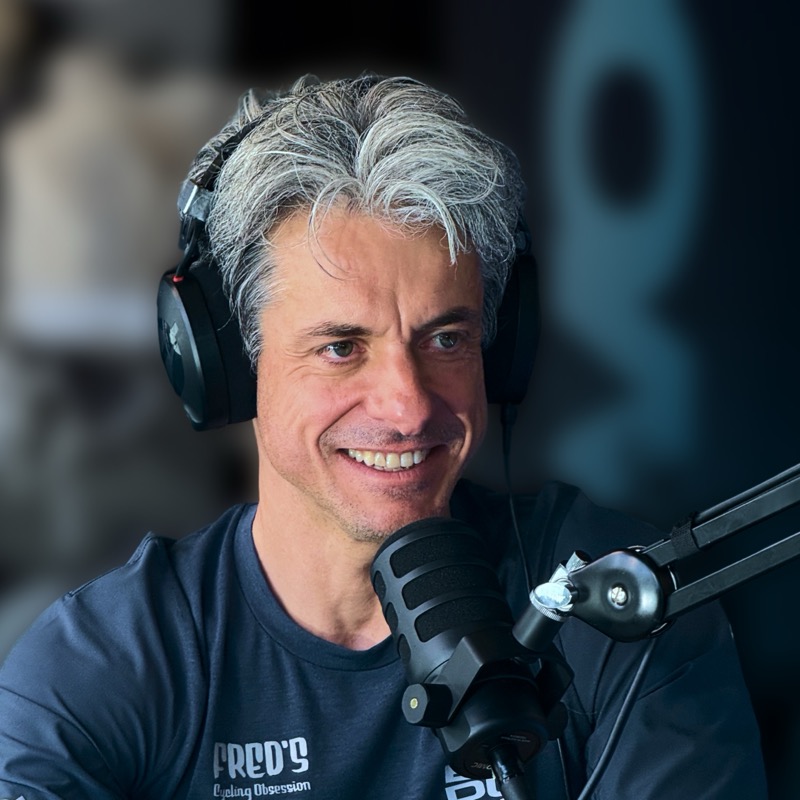
Creator of «La Obsesión Ciclista de Fred», the most-listened Spanish-language cycling podcast (6M+ plays). 20+ years building technology, much of it for sport.
Prepared by the FredCoach science team, AI-assisted, from the cited sources · Sport psychologist
In short. Nerves before a race are normal and, on their own, are only weakly linked to performance: your confidence is linked more. What the research supports best is a routine for race morning, rehearsing the race in your head and setting goals about what you control; a few minutes of slow breathing help lower the stress you feel, although they won't make you faster.
Nerves are not the enemy
The churning stomach, the racing pulse on the start line, the bad night's sleep before. Almost everyone goes through it, professionals included. The question is whether it costs you, and the science is reassuring.
A meta-analysis of 48 studies found that worry before competing is only weakly linked to performance, and that confidence that you can do it is linked more. Both links are small and clearly stronger at high-level competition; at lower levels, worry was barely linked at all. These are associations, not causes. In other words, you don't need to arrive calm to have a good race. You need to arrive trusting what you have prepared.
That arousal is also your body getting ready: higher heart rate, more alertness, more energy available. It is not a sign that something is wrong.
Call it excitement
In a series of experiments, telling yourself "I am excited" before a nerve-wracking task worked better than trying to calm down. The idea is not to fight the arousal but to change how you read it. Note that those experiments involved singing, public speaking and maths problems, not endurance events. It is an interesting lead rather than something proven in cycling, but it costs nothing to try: when you feel your pulse on the start line, instead of fighting it, call it excitement.
A routine for race morning
Pre-performance routines improve performance: a little in before-and-after studies and moderately to strongly in experiments, including under pressure. The type of routine made no difference. Most of those studies involve precision skills (a shot, a serve), not endurance, so for cycling what follows is the practice of sport psychologists rather than a trial:
- The night before: bike checked, kit and gels ready, number pinned on. Leave no decisions for the morning.
- Breakfast: one you have already tried before a long training ride. Nothing new on race day.
- Arrival: a time set in advance, with room for the toilet, the queue and the warm-up.
- Warm-up: one you already know from training; how much depends on the event.
The routine removes decisions and keeps your nerves on what you can control.
Rehearse the race in your head
Imagery, mentally rehearsing the event, improves performance, motivation and mood with a medium effect according to a large meta-analysis, it adds to real practice, and it works better the more you practise it. In the days before, close your eyes for a few minutes and ride the course: the start, the first climb at your pace, the feed zone, the moment it gets hard and what you will do then (drink, relax your shoulders, aim for the next landmark). Rehearsing the bad moment too means that when it comes, you already know it.
Goals that depend on you
In sport, process goals (what you control while racing: climbing at your pace, eating to your plan, holding your cadence) are the ones that improve performance most; outcome goals (your position, winning) barely move it. The gap is large, although it comes from few studies of each type, so take it with some caution.
A long event feels more manageable in chunks: reach the feed zone, the next climb at your pace, the next village. That is sport psychology practice, consistent with the above.
And what you tell yourself counts. Two weeks of motivational self-talk training ("keep going, you're doing well") extended time to exhaustion on the bike by 18% in a lab trial with 24 people. In a real 60-mile (97 km) ultra it did not change finishing times, although most found it useful and were still using it months later. It helps, without miracles.
Slow breathing: what it does and what it doesn't
Guided breathing reduces the stress and anxiety you feel, with a small-to-moderate effect according to a meta-analysis of trials. In a study with students, five minutes a day for a month of cyclic sighing, box breathing, fast breathing with breath holds or meditation all lowered anxiety, and cyclic sighing improved mood a little more than meditation. No technique has been shown to beat the others: pick the one that suits you.
A simple way: breathe slowly, about six times a minute, letting the air out a bit longer than you take it in (for example, four seconds in and six out), for about five minutes (five to ten). You can use it the night before to unwind and in the start pen.
What it doesn't do: it does not improve endurance performance, and its effect on heart rate variability fades soon after you stop. And a warning: never hyperventilate and then hold your breath. It can make you pass out without warning. If you feel dizzy, stop and breathe at your own pace.
When it is more than nerves
If the anxiety doesn't stay in the days before the race, if it lasts for weeks, keeps you awake or gets in the way of work, stops you enjoying things you used to like or shows up outside sport too, talk to your doctor or a psychologist. It is common in athletes as well, it can be treated, and asking for help is part of looking after yourself, not a weakness. And if you ever think about harming yourself, don't wait: contact your local emergency number or crisis line.

FAQ
Is it bad to be nervous before a race?
No. Nerves are normal and, according to a meta-analysis of 48 studies, are only weakly linked to performance; confidence in what you have prepared is linked more. Your body is gearing up to compete.
How can I sleep better the night before a race?
Get everything ready so no decisions are left for the morning, and try 15–20 minutes of slow breathing before bed: in two small trials in healthy people it improved sleep. Sleeping worse the night before is very common: in a survey of elite athletes, two in three had experienced it, mostly from thinking about the race.
Which breathing technique is best for nerves?
None has been shown to beat the others: slow breathing, cyclic sighing and box breathing lower anxiety by a similar amount. Pick the one you find comfortable and avoid hyperventilating or holding your breath for long.
Does visualising the race help?
Yes. Mentally rehearsing the event improves performance with a medium effect and adds to your training. Include the hard moment too, and what you will do when it comes.
Sources
- Woodman T, Hardy L (2003). The relative impact of cognitive anxiety and self-confidence upon sport performance: a meta-analysis. Journal of Sports Sciences 21(6):443–457 · doi
- Brooks AW (2014). Get excited: reappraising pre-performance anxiety as excitement. Journal of Experimental Psychology: General 143(3):1144–1158 · doi
- Rupprecht AGO, Tran US, Gröpel P (2021). The effectiveness of pre-performance routines in sports: a meta-analysis. International Review of Sport and Exercise Psychology 17(1):39–64 · doi
- Simonsmeier BA, Andronie M, Buecker S, Frank C (2020). The effects of imagery interventions in sports: a meta-analysis. International Review of Sport and Exercise Psychology 14(1):186–207 (en línea 2020; en papel 2021) · doi
- Williamson O, Swann C, Bennett KJM, Bird MD, Goddard SG, et al. (2022). The performance and psychological effects of goal setting in sport: a systematic review and meta-analysis. International Review of Sport and Exercise Psychology 17(2):1050–1078 · doi
- Blanchfield AW, Hardy J, de Morree HM, Staiano W, Marcora SM (2014). Talking yourself out of exhaustion: the effects of self-talk on endurance performance. Medicine and Science in Sports and Exercise 46(5):998–1007 · doi
- McCormick A, Meijen C, Marcora S (2018). Effects of a motivational self-talk intervention for endurance athletes completing an ultramarathon. The Sport Psychologist 32(1):42–50 · doi
- Fincham GW, Strauss C, Montero-Marin J, Cavanagh K (2023). Effect of breathwork on stress and mental health: a meta-analysis of randomised-controlled trials. Scientific Reports 13:432 · doi
- Balban MY, Neri E, Kogon MM, Weed L, Nouriani B, Jo B, et al. (2023). Brief structured respiration practices enhance mood and reduce physiological arousal. Cell Reports Medicine 4(1):100895 · doi
- Röttger S, Theobald DA, Abendroth J, Jacobsen T (2021). The effectiveness of combat tactical breathing as compared with prolonged exhalation. Applied Psychophysiology and Biofeedback 46:19–28 · doi
- Laborde S, Hosang T, Mosley E, Dosseville F (2019). Influence of a 30-day slow-paced breathing intervention compared to social media use on subjective sleep quality and cardiac vagal activity. Journal of Clinical Medicine 8(2):193 · doi
- Craig AB (1976). Summary of 58 cases of loss of consciousness during underwater swimming and diving. Medicine and Science in Sports 8(3):171–175 · doi
- Gouttebarge V, Castaldelli-Maia JM, Gorczynski P, et al. (2019). Occurrence of mental health symptoms and disorders in current and former elite athletes: a systematic review and meta-analysis. British Journal of Sports Medicine 53(11):700–706 · doi
- Juliff LE, Halson SL, Peiffer JJ (2015). Understanding sleep disturbance in athletes prior to important competitions. Journal of Science and Medicine in Sport 18(1):13–18 · doi