

How much strength training does a cyclist need, and when?

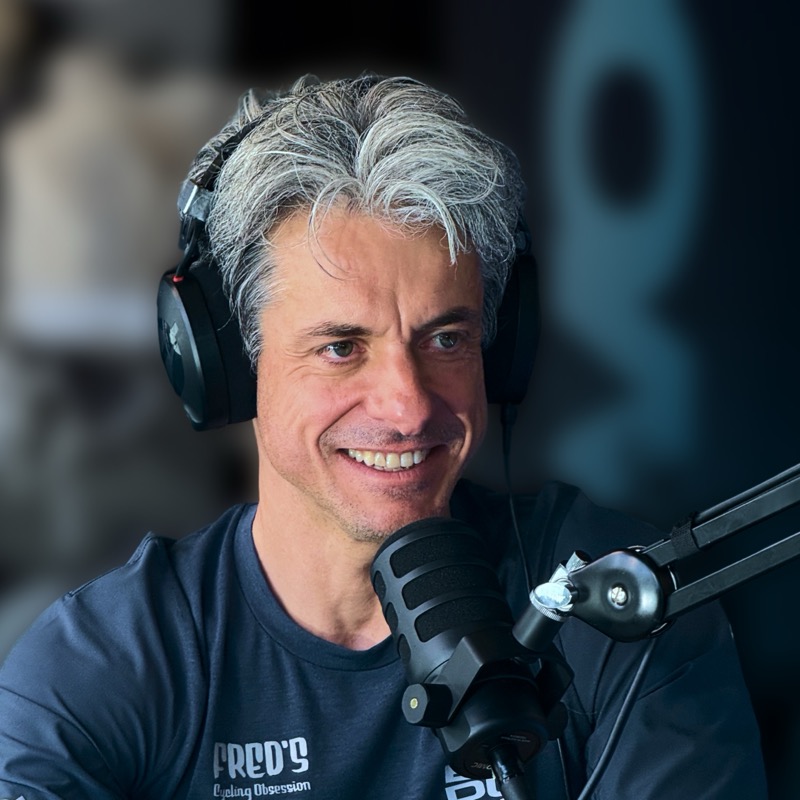
Creator of «La Obsesión Ciclista de Fred», the most-listened Spanish-language cycling podcast (6M+ plays). 20+ years building technology, much of it for sport.
Prepared by the FredCoach science team, AI-assisted, from the cited sources · Cross-training scientist
In short. What has been tested in cyclists is heavy strength training (few reps with a heavy load) twice a week for two to three months, then once a week to maintain it. It improves cycling performance a little, probably by making you more economical on the bike and adding short, punchy power, not by raising your threshold; the studies are few and small. Where you put it matters as much as how much: not the day before your key bike session.
What does strength training do for a cyclist?
The most recent meta-analysis, from 2026, pooled 17 studies with 262 endurance cyclists, well trained on average (60 of them women), who added heavy strength training to their riding for 5 to 25 weeks. Compared with those who only rode, they improved cycling performance (time trials and time to exhaustion), cycling efficiency (the watts you get for each unit of energy) and anaerobic power, the power of short, explosive efforts. Maximal oxygen uptake and threshold did not change.
The authors themselves rate the certainty of the evidence as low, because the studies are few and small. The effect also shows up in individual trials: in 19 well-trained female cyclists, 11 weeks of heavy lifting improved a 40-minute time trial and cycling economy, and the ride-only group did not improve.
Strength work does not give you a bigger engine: it helps you burn less fuel with the one you have.
Heavy weights or lots of light reps?
The Norwegian trials that improve performance use heavy loads: three sets of 4 to 10 reps, close to the most you can lift, in four leg exercises built around the half squat and the single-leg leg press.
High-rep, light-weight training, the kind that feels more "endurance-like", showed no clear improvement in performance in endurance athletes, either compared with doing nothing or with low-rep training, in a 2023 meta-analysis. It has its limits: short studies of around eight weeks, mostly with recreational athletes.
And for sprinting, the gym is not the shortcut: in 28 competitive cyclists, short sprints on the bike improved sprinting more, and heavy lifting improved the squat more. Each stimulus mainly improves what it trains.
How many strength sessions a week?
The tested approach comes mostly from Bent Rønnestad's group in Norway: two sessions a week for about 12 weeks of preparation, then one a week during the season. On that plan, well-trained cyclists kept their strength gains through 13 weeks of racing and improved their 40-minute time trial more than riders who only rode. It is a small study: six cyclists per group.
The opposite has been measured too: in 14 elite cyclists who had lifted for 25 weeks, stopping completely for the first 8 weeks of the season wiped out much of their advantage in jumping, maximal aerobic power and 30-second sprint power. Keeping one session a week looks like the way to hold on to your gains.
Nobody knows the minimum dose: in the 2026 meta-analysis, neither frequency (one to three sessions a week) nor duration clearly changed the effect. Two, then one, is what has been tested, not a proven optimum.
What if I'm short on time for strength work?
In a review of five trials with highly trained cyclists, the studies that replaced part of the riding with strength work improved time-trial performance; the ones that added it on top of everything else did not. That does not prove you should ride less, but it is a warning: strength work helps when it fits, not when it piles up.
In a survey of 555 masters cyclists, all men, more of them lift in winter than during the season, and their biggest obstacles are time and fatigue. As our practical advice, not a trial result: one weekly session you keep all year is worth more than an ambitious block you abandon in March.
Which day should strength go on, relative to my rides?
Strength sessions leave fatigue lasting hours to days, which can spoil the next endurance session (2017 review). In ten cyclists who were not used to lifting, after one heavy session their jump was worse and pedalling felt harder at 24 and 48 hours, although they held their time-trial performance. The second session caused less soreness: the first few sessions are the ones you feel most.
What does not happen is riding stealing your strength. A meta-analysis of 43 studies found that combining endurance and strength training does not hold back maximal strength or muscle growth; only explosive strength suffers a little, mostly in the same session, and with at least three hours in between the effect was no longer seen.
Within a single session, lifting first gave about 4 kg more in maximal leg strength and the same oxygen uptake. Those trials did not measure your key ride. If the bike is your priority, the practical advice, not tested in a trial, runs the other way: key ride first, strength a few hours later, and never heavy lifting the day before a key session.
Where does the fear that lifting and riding clash come from?
From a 1980 study. Robert Hickson had a group train strength five days a week and endurance six, at the same time, for ten weeks. Their maximal oxygen uptake rose as much as in the endurance-only group, but their leg strength plateaued after week seven and fell in weeks nine and ten. That is how the "interference effect" was born.
It was a huge workload, far from an amateur's week. Today's meta-analyses see small interference: it holds back leg strength a little in men, was not seen in women, and oxygen uptake only suffers in people who were untrained.
What we still don't know about strength for cyclists
- The minimum dose that works for an amateur training six to eight hours a week.
- How much strength training helps female cyclists: there are few trials.
- Whether non-elite riders hold their gains just as well on one session a week.

FAQ
Will lifting weights cost me endurance on the bike?
It does not seem to. In trials with cyclists, maximal oxygen uptake and threshold held steady with heavy strength training and cycling performance improved slightly, although the studies are still few and small. The interference that has been described mainly affects explosive strength, not endurance.
Can I keep lifting during the race season?
Yes, and it pays to: one session a week preserved the gains in well-trained cyclists, and stopping completely wiped out much of them within about eight weeks in elite cyclists. These are two small studies, but they agree.
Should I lift before or after riding on the same day?
Within one session, lifting first produced slightly more strength without changing oxygen uptake. If your key bike session matters most, the practical advice is to do it first and leave a few hours before lifting: with at least three hours between them, they barely interfere.
Is strength training worth it after 40?
Yes. In a small study of endurance athletes around 50, three weeks of quadriceps extensions raised strength more than in younger athletes and improved cycling efficiency. Between 50 and 73, combining strength and endurance training improves strength, power and endurance compared with not training (15 trials).
Sources
- Llanos-Lagos C, Ramirez-Campillo R, Sáez de Villarreal E (2026). Heavy strength training effects on physiological determinants of endurance cyclist performance: a systematic review with meta-analysis. European Journal of Applied Physiology 126(1):193–222 · doi
- Vikmoen O, Ellefsen S, Trøen Ø, Hollan I, Hanestadhaugen M, Raastad T, Rønnestad BR (2016). Strength training improves cycling performance, fractional utilization of VO2max and cycling economy in female cyclists. Scandinavian Journal of Medicine & Science in Sports 26(4):384–396 · doi
- Nugent FJ, Flanagan EP, Darragh I, Daly L, Warrington GD (2023). The effects of high-repetition strength training on performance in competitive endurance athletes: a systematic review and meta-analysis. Journal of Strength and Conditioning Research 37(6):1315–1326 · doi
- Kristoffersen M, Sandbakk Ø, Rønnestad BR, Gundersen H (2019). Comparison of short-sprint and heavy strength training on cycling performance. Frontiers in Physiology 10:1132 · doi
- Rønnestad BR, Hansen EA, Raastad T (2010). In-season strength maintenance training increases well-trained cyclists' performance. European Journal of Applied Physiology 110(6):1269–1282 · doi
- Rønnestad BR, Hansen J, Hollan I, Spencer M, Ellefsen S (2016). Impairment of performance variables after in-season strength-training cessation in elite cyclists. International Journal of Sports Physiology and Performance 11(6):727–735 · doi
- Yamamoto LM, Klau JF, Casa DJ, Kraemer WJ, Armstrong LE, Maresh CM (2010). The effects of resistance training on road cycling performance among highly trained cyclists: a systematic review. Journal of Strength and Conditioning Research 24(2):560–566 · doi
- Vikestad V, Dalen T (2024). Strength training among male master cyclists: practices, challenges, and rationales. Journal of Functional Morphology and Kinesiology 9(4):232 · doi
- Doma K, Deakin GB, Bentley DJ (2017). Implications of impaired endurance performance following single bouts of resistance training: an alternate concurrent training perspective. Sports Medicine 47(11):2187–2200 · doi
- Devantier-Thomas B, Deakin GB, Crowther F, Schumann M, Doma K (2024). The repeated bout effect of traditional resistance training on cycling efficiency and performance. European Journal of Applied Physiology 124(7):2005–2017 · doi
- Schumann M, Feuerbacher JF, Sünkeler M, Freitag N, Rønnestad BR, Doma K, Lundberg TR (2022). Compatibility of concurrent aerobic and strength training for skeletal muscle size and function: an updated systematic review and meta-analysis. Sports Medicine 52(3):601–612 · doi
- Huiberts RO, Wüst RCI, van der Zwaard S (2024). Concurrent strength and endurance training: a systematic review and meta-analysis on the impact of sex and training status. Sports Medicine 54(2):485–503 · doi
- Murlasits Z, Kneffel Z, Thalib L (2018). The physiological effects of concurrent strength and endurance training sequence: a systematic review and meta-analysis. Journal of Sports Sciences 36(11):1212–1219 · doi
- Hickson RC (1980). Interference of strength development by simultaneously training for strength and endurance. European Journal of Applied Physiology and Occupational Physiology 45(2–3):255–263 · doi
- Louis J, Hausswirth C, Easthope C, Brisswalter J (2012). Strength training improves cycling efficiency in master endurance athletes. European Journal of Applied Physiology 112(2):631–640 · doi
- Markov A, Hauser L, Chaabene H (2023). Effects of concurrent strength and endurance training on measures of physical fitness in healthy middle-aged and older adults: a systematic review with meta-analysis. Sports Medicine 53(2):437–455 · doi