

Does running hurt my cycling? What the science says

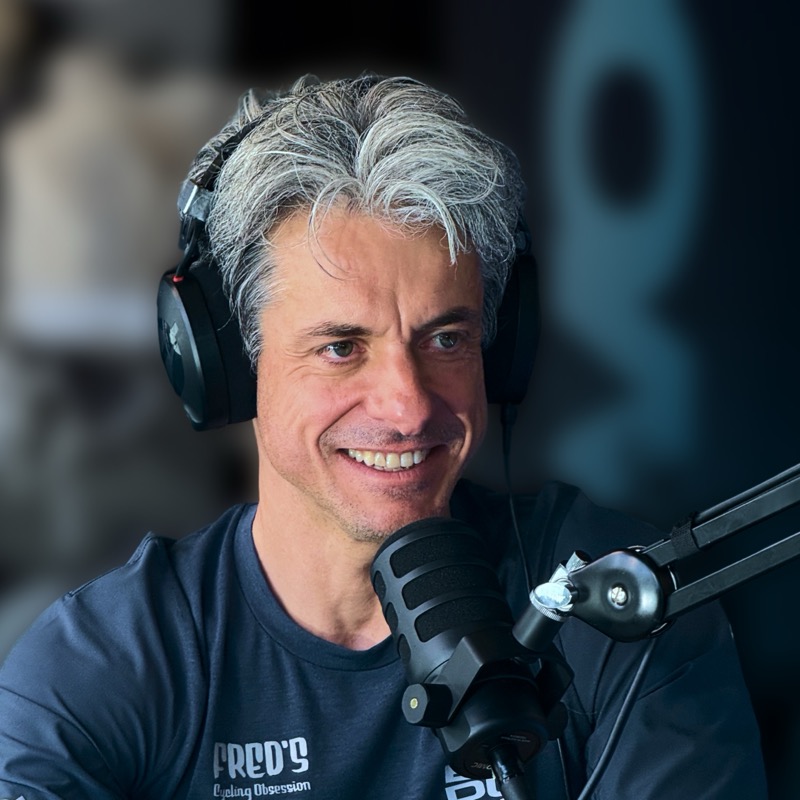
Creator of «La Obsesión Ciclista de Fred», the most-listened Spanish-language cycling podcast (6M+ plays). 20+ years building technology, much of it for sport.
Prepared by the FredCoach science team, AI-assisted, from the cited sources · Cross-training scientist
In short. It depends on how you run. An easy flat run you already do often barely affects the next day's ride; a long downhill or a run you are not used to can leave your legs worse for two to four days, even once the soreness is gone. Running keeps your aerobic engine going, but it does not replace riding if you want to perform on the bike.
What running does give you
Your heart and lungs are the same whether you run or ride, so some fitness carries over. But the adaptations that matter most for performance, such as maximal oxygen uptake measured in your own sport or your threshold, are largely specific: muscle adapts to the task it does. Two reviews suggest that more probably carries over from running to cycling than the other way round, and that it never carries over as much as training the sport itself.
A small 2026 meta-analysis of seven trials compared training only by running or only by cycling: found no clear difference in maximal oxygen uptake, with a slight trend favouring the sport trained and a lot of uncertainty; the authors warn this does not show they are interchangeable. What nobody has measured is how many watts on the bike an hour of running is worth for an amateur cyclist.
Running also brings something cycling does not: impact. Road cyclists tend to have lower bone density in the spine, and mixing in other sports might soften that; in one small study, cyclists were seven times more likely than runners to have low bone density in the spine. These studies compare groups at one point in time, they are not trials: they do not show that running protects a cyclist's bones.
Why running tires you differently
The difference is impact and eccentric work: the muscle brakes while it lengthens, especially downhill. On the bike it hardly exists. That braking is what causes the small muscle damage you feel as soreness.
Downhill running in the lab cut quadriceps strength by 16% to 24%, with soreness peaking at 48 hours. In trained people strength had recovered by 72 hours; in untrained people, not yet by 96. It comes from a review of many lab studies with downhill runs of about 40 minutes; the protocols vary, but the pattern repeats.
And that damage reaches the bike. A 2024 meta-analysis found that after muscle-damaging exercise, maximal power on the bike (sprints and incremental tests) drops at 24 to 48 hours and, at the same watts, perceived effort goes up, even though oxygen uptake does not change; time-trial performance, however, did not get worse. Note that the damage came from lab protocols designed to damage muscle, not from ordinary runs.
After a long effort, nervous system fatigue and loss of strength are also greater after running than after cycling.
What you're not used to costs the most
The factor that matters most has a name: the repeated bout effect. Muscle that has already done a similar effort is damaged much less the next time. That is why a regular runner barely notices an easy run, while a cyclist who runs down a mountain for the first time in months feels it for days. In marathoners with many races behind them, damage after a marathon was minimal and soreness was gone by day two.
One detail is misleading: how you feel recovers before your legs do. In a study of 27 recreational runners, after a 20 km run with climbing, soreness was gone by day 3 or 4, but jump height was still below normal on those same days. No longer hurting does not mean your legs are back to full strength.
How many days does it affect the bike?
- Easy, familiar flat run: little or nothing.
- Steep downhill or a run you're not used to (the first after a break, the longest of the month): expect two to four days of weaker legs, even without pain.
- Trail with lots of climbing: an hour on trails is not an hour on the flat. The downhill adds damage and the uphill adds cost. In mountain races up to 60 km nervous system fatigue weighs more; muscle damage becomes obvious in races of 100 km or more.
- Marathon: muscle damage markers stayed high for four to eight days in a study of recreational marathoners. Going back to an easy run at 48 hours did not slow recovery in another trial.
And good news for cyclists: after lab-induced damage to the quadriceps, moderate pedalling was no worse than resting in a small trial (30 men). An easy ride the next day is a reasonable choice.
How to combine them without losing your legs
These are our practical tips, drawn from the above, not trials with cyclists:
- Put the run, especially if it has downhill, after your quality bike session rather than in the two days before it.
- If cycling is your goal, build your running gradually: the longest run of the month and the unfamiliar downhill are what cost the most.
- Don't use your cycling heart rate zones for running: heart rate behaves differently in the two sports.
If you are starting to run, look after your tendons. A fit cyclist has the engine of a regular runner and the skeleton of a beginner: their heart lets them run more than their tendons can handle (this is our inference, not a study of cyclists). People starting to run get injured more than twice as often per hour as regular runners (17.8 versus 7.7 injuries per 1,000 hours, according to a meta-analysis of 13 studies of runners, not cyclists). In a study of more than 5,000 runners and their watches, a single run more than 10% longer than the longest of the previous month was linked to more overuse injuries; it is an observational study and does not prove cause. And the famous "10% weekly rule" is not proven: a trial with beginners found no fewer injuries when following it.
What we still don't know
- How many watts on the bike an hour of running is worth for an amateur cyclist.
- Exactly how much an hour of downhill trail running weighs on the next day's ride.

FAQ
Does running improve cycling performance?
It keeps your aerobic engine going and helps somewhat, especially if you ride little, but the adaptations that matter most are specific: to perform on the bike, nothing replaces riding. Nobody has measured how many watts an hour of running adds.
How long after a run can I do a hard bike session?
After a familiar easy run, the next day. After a long downhill or a run you are not used to, as a practical rule, leave two or three days before the hard session, even if the soreness has gone: strength comes back later than how you feel.
Why do I get injured when I start running if I'm fit on the bike?
Probably because your heart adapts faster than your tendons and bones. Your cycling fitness lets you run more than your body, unused to impact, can take. Start small and let your longest run grow slowly (this is our reading, not something measured in cyclists).
Sources
- Millet GP, Vleck VE, Bentley DJ (2009). Physiological differences between cycling and running: lessons from triathletes. Sports Medicine 39(3):179–206 · doi
- Tanaka H (1994). Effects of cross-training: transfer of training effects on VO2max between cycling, running and swimming. Sports Medicine 18(5):330–339 · doi
- Menges T, Dindorf C, Dully J, Fröhlich M (2026). Cross-training between running and cycling: effects on VO2max and running performance—a systematic review and meta-analysis. Frontiers in Sports and Active Living 8:1843803 · doi
- Olmedillas H, González-Agüero A, Moreno LA, Casajús JA, Vicente-Rodríguez G (2012). Cycling and bone health: a systematic review. BMC Medicine 10:168 · doi
- Rector RS, Rogers R, Ruebel M, Hinton PS (2008). Participation in road cycling vs running is associated with lower bone mineral density in men. Metabolism 57(2):226–232 · doi
- Bontemps B, Vercruyssen F, Gruet M, Louis J (2020). Downhill running: what are the effects and how can we adapt? A narrative review. Sports Medicine 50(12):2083–2110 · doi
- Devantier-Thomas B, Deakin GB, Crowther F, Schumann M, Doma K (2024). The impact of exercise-induced muscle damage on various cycling performance metrics: a systematic review and meta-analysis. Journal of Strength and Conditioning Research 38(8):1509–1525 · doi
- Clifford T, Allerton DM, Brown MA, Harper L, Horsburgh S, Keane KM, Stevenson EJ, Howatson G (2017). Minimal muscle damage after a marathon and no influence of beetroot juice on inflammation and recovery. Applied Physiology, Nutrition, and Metabolism 42(3):263–270 · doi
- Macchi R, Kunimasa Y, Chavet P, et al., Nicol C (2024). Effect of a graded running race on lower limb muscle damage, jump performance and muscle soreness in men and women. Scandinavian Journal of Medicine & Science in Sports 34(5):e14643 · doi
- Muñoz de la Cruz V, González-Mohíno F, García-Pinillos F, Jaén-Carrillo D (2026). Decoding neuromuscular fatigue in trail running: a systematic review across distances and sex differences. International Journal of Sports Physiology and Performance 21(6):698–707 · doi
- Bernat-Adell MD, Collado-Boira EJ, Moles-Julio P, Panizo-González N, Martínez-Navarro I, Hernando-Fuster B, Hernando-Domingo C (2021). Recovery of inflammation, cardiac, and muscle damage biomarkers after running a marathon. Journal of Strength and Conditioning Research 35(3):626–632 · doi
- Martínez-Navarro I, Montoya-Vieco A, Hernando C, Hernando B, Panizo N, Collado E (2021). The week after running a marathon: effects of running vs elliptical training vs resting on neuromuscular performance and muscle damage recovery. European Journal of Sport Science 21(12):1668–1674 · doi
- de Azevedo Franke R, Rodrigues R, Geremia JM, Teixeira BC, Boeno F, Rabello R, Baroni BM, Lima CS (2021). Moderate intensity cycling is better than running on recovery of eccentric exercise-induced muscle damage. Physical Therapy in Sport 50:65–73 · doi
- Videbæk S, Bueno AM, Nielsen RO, Rasmussen S (2015). Incidence of running-related injuries per 1000 h of running in different types of runners: a systematic review and meta-analysis. Sports Medicine 45(7):1017–1026 · doi
- Frandsen JSB, Hulme A, Parner ET, et al., Nielsen RO (2025). How much running is too much? Identifying high-risk running sessions in a 5200-person cohort study. British Journal of Sports Medicine 59(17):1203–1210 · doi
- Buist I, Bredeweg SW, van Mechelen W, Lemmink KAPM, Pepping GJ, Diercks RL (2008). No effect of a graded training program on the number of running-related injuries in novice runners: a randomized controlled trial. American Journal of Sports Medicine 36(1):33–39 · doi